
In January 2001 the Post Office announced it was renaming itself Consignia. The reasoning was not stupid, whatever the subsequent press suggested. The group did logistics and contact centres as well as letters, it was eyeing international acquisitions, and the chief executive pointed out that a 350 year old name could not be legally protected and did not distinguish it from every other national postal administration.
The rebrand cost about two million pounds. The name survived fifteen months.
By June 2002 the company was preparing to become Royal Mail, and the press reported the reversal would cost around another million. That second figure is the one worth stopping on, because of what was driving it.
Where the money went
The main cost of going back was not creative work, and it was not advertising. It was changing the Consignia signs on roughly 3,000 buildings, and the reason given was not aesthetic preference. It was to meet company law requirements.
Vans and uniforms were already branded Royal Mail or Parcelforce, so they cost nothing. Stocks of items carrying the Consignia name were simply to be used up before reordering. The company said openly that it wanted to do this at minimum cost, and it still landed near a million, because the signage was not optional.
A company must display its registered name where it does business. That is not a brand guideline anyone can phase in over eighteen months. It is a statutory display obligation, and when the registered name changes, every physical instance of the old one becomes non-compliant on a date somebody else sets.
The interesting part is the inventory
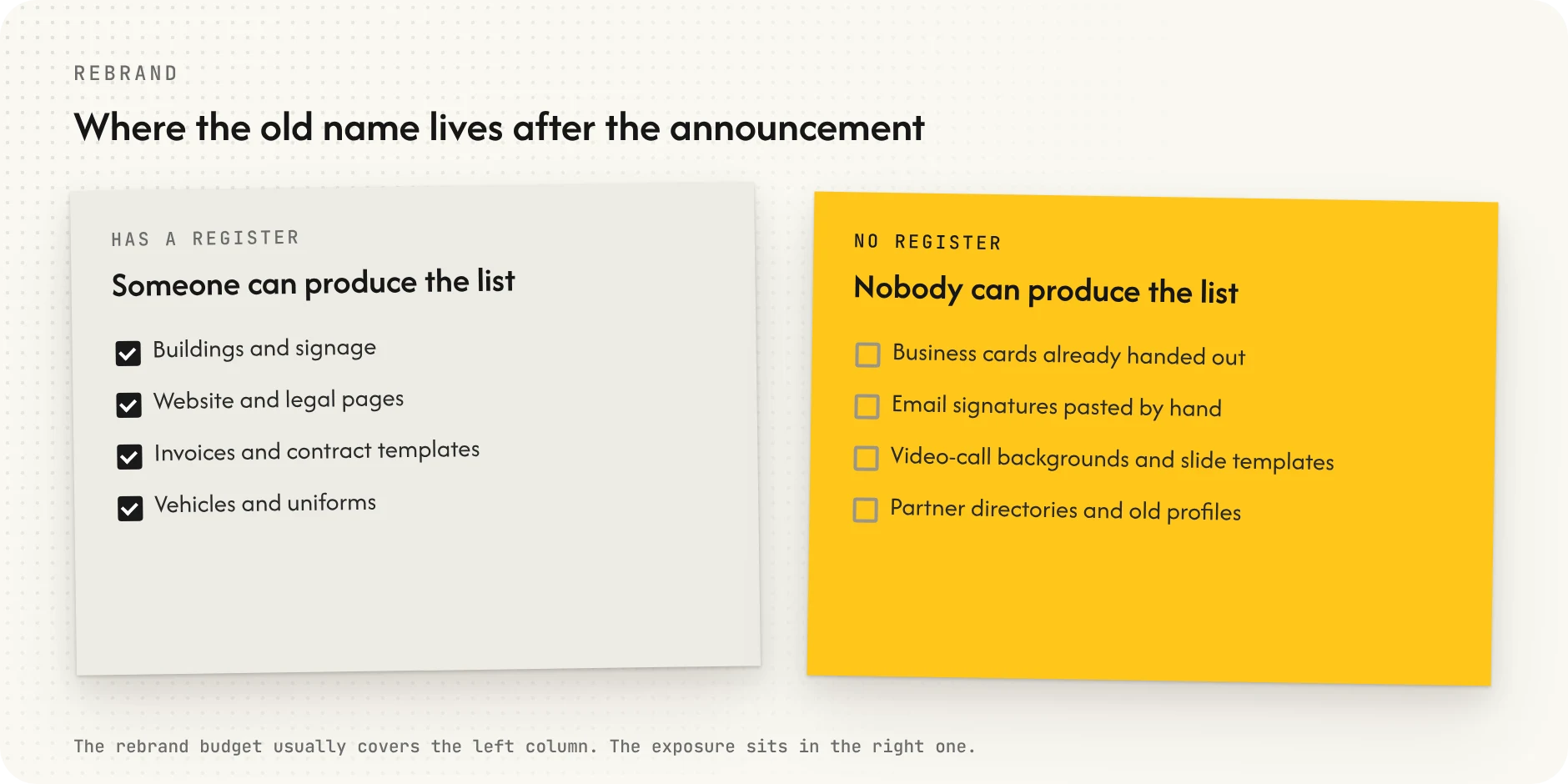
Three thousand buildings is a number that exists because a postal operator knows where its buildings are. It has an estate register. Somebody can produce the list.
That is the easy case. The hard case is everything that carries the company's identity and is not in any register at all.
Business cards are the clearest example. They are printed locally, ordered by departments, distributed to individuals, and then handed to strangers, at which point they leave the organisation permanently. A rebrand does not retire them. It creates two populations, the correct one and the obsolete one, and the obsolete population is undocumented, uncollectable and still circulating.
Email signatures are the same shape with a different failure mode. They can in principle be changed everywhere at once, but only if they are deployed centrally. Where they were distributed as a template that people pasted in themselves, there is no list of where they live either.
Caution
A rebrand programme is usually scoped against the assets somebody has a register for. The exposure sits in the ones nobody does.
A rebrand checklist for the places nobody registers
Before the new name is announced, someone should be able to tick every line below with a number next to it.
- Registered details: legal name, number and address on the website footer, invoices, contracts and letterhead.
- Email signatures: every user, every mail client, every shared mailbox, including the legal line.
- Business cards: printed stock by office, digital cards and wallet passes, and an estimate of how many old cards are in circulation.
- Video and presentation: call backgrounds, slide templates and event stand graphics.
- Systems of record: company name fields in the HR system, directory and CRM, which feed everything above.
- Public profiles: social accounts, app store listings, review sites and partner directories.
Why this is not just a rebrand problem
Rebrands are rare, which is why this looks like an edge case. It is not, because the same mechanism fires on much more ordinary events.
A company moves its registered office. It restructures a subsidiary and the legal form changes. It is acquired and the registered entity behind the trading name becomes a different company. A managing director resigns. Each of those changes a fact that appears on identity artifacts, and each of them originates as a filing rather than as a project with a budget and a brand lead.
The rebrand is simply the version loud enough that somebody gets funded to deal with it. The quieter changes produce the same drift and get no programme at all.
What Consignia actually demonstrates
The lesson usually drawn from Consignia is about naming, and it is the less useful one. Plenty of invented corporate names from that era survived perfectly well.
The durable lesson is arithmetic. The decision to change a name is made in one room, in one meeting, and costs nothing at the moment it is made. The cost is entirely in reconciliation, and reconciliation is priced by how many uncatalogued places the old identity is currently sitting.
Which means the real question in front of a board contemplating a rebrand is not what the new name should be. It is: can anyone produce the list of everywhere the current one appears?
For buildings, the answer is usually yes. For signage, yes. For the website, yes. For the four hundred cards handed out at trade shows over the last two years, and the several hundred signature blocks each employee edits at will, the answer is no, and nobody notices it is no until the name changes.
I work in this category, so weigh that accordingly. The argument I would make is that the register is not a thing you build during a rebrand. By then it is too late and you are buying it at panic prices. It is a thing that either exists already as a consequence of how cards and signatures are issued, or does not exist at all. The same logic applies when someone leaves, which we covered in Nobody asks for the cards back.
Consignia knew where its three thousand buildings were. That is why that part only cost a million.
Planning a rebrand? Book a demo and see how DBC1 updates every card and signature from one record.