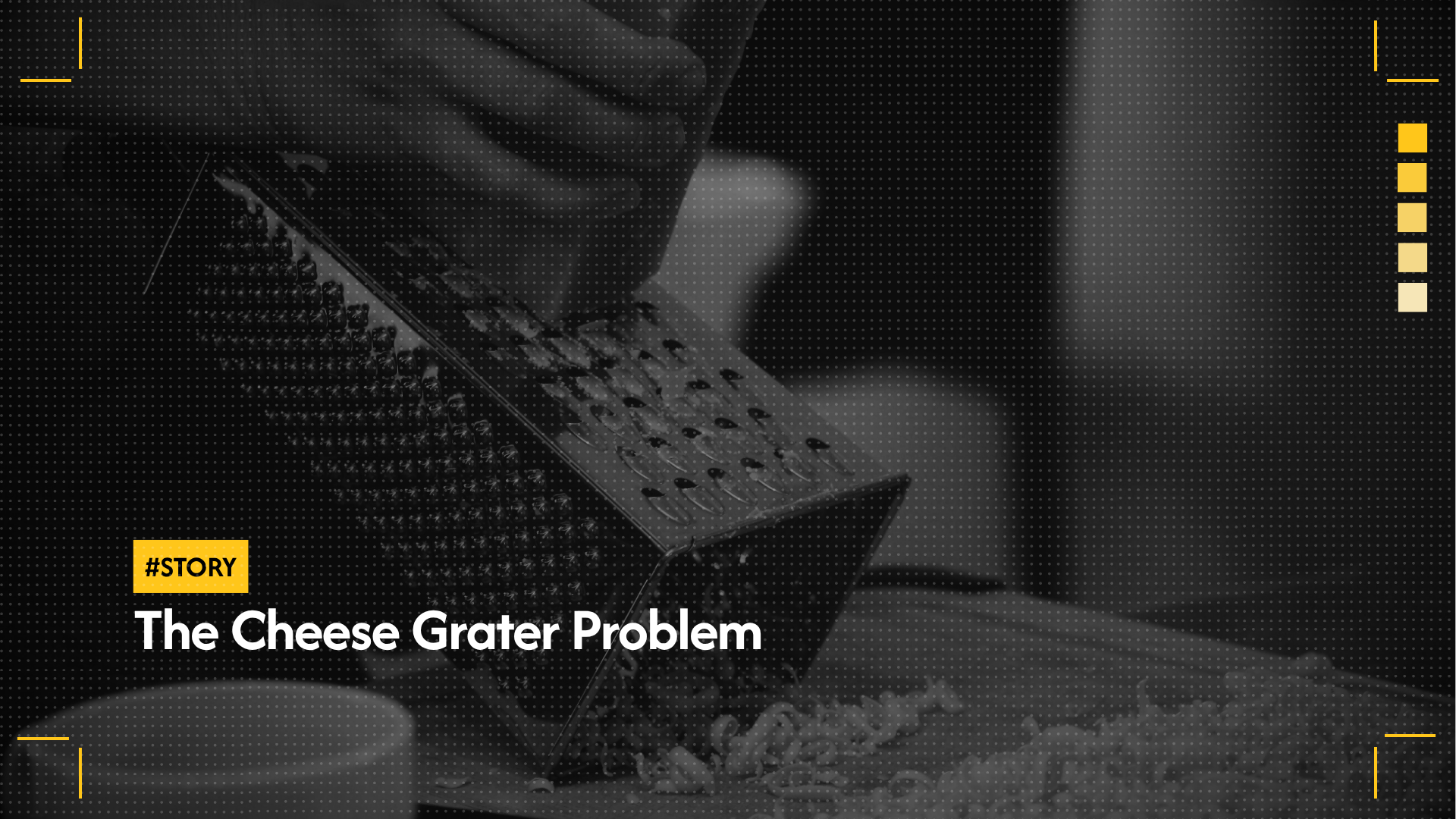
In Curitiba, Brazil, a cheese shop called Bon Vivant handed out business cards made of metal, punched with the same raised holes you'd find on a box grater. They worked. You could take one home and grate parmesan with it.
The first run of a thousand went in four days. The shop had to impose a rule: one card per customer per week.
By any normal marketing measure this is a triumph. People wanted the card. People took the card. People kept the card. And yet I'd argue it failed at the only job a business card has, and understanding why turns out to explain almost every strange business card ever made.
Everything on this list is answering one question
The question is: how do I stop this being thrown away?
It's the anxiety underneath the entire category. You hand over a small piece of card, and within seconds it enters a race between someone's memory and someone's bin. Every unusual card ever produced is an attempt to rig that race.
The attempts split into two strategies. One of them mostly doesn't work.
Strategy one: make it useful
The grater is the purest example, but the genre is large. A bike mechanic in Canada handed out a metal card you could use to tighten a nut or untangle a chain. A cleaning-products company made a card that turned into a full-size sponge when you wet it, while staying barely thicker than paper when dry. A yoga studio in Vancouver made a miniature foam mat that rolled up like the real thing.
These are inventive, and they get written about, which is presumably part of the point. But watch what happens to the object afterwards.
The grater goes in the kitchen drawer. The bike tool goes in the saddlebag. The sponge goes under the sink, and after four days of washing up, whatever was printed on it is gone. Each of these cards survives — and each of them survives somewhere other than where cards are kept. It's no longer in a wallet, a cardholder, or the tray on someone's desk where they look when they're trying to remember who that supplier was.
You've won the object and lost the function. The card is now a possession rather than a pointer.
There's a second problem, less discussed. Most of these things can't actually be handed over in the situation cards are for. You can't produce a punched sheet of metal in a meeting, or a mini yoga mat at a trade fair, without the exchange becoming about the object. Which is fine if you're a cheese shop and the object is the marketing. It's less fine if you were hoping to talk about something else.
Strategy two: make the object demonstrate the work
The other strategy keeps the card a card, and makes its form an argument.
The best-known example is a Canadian divorce lawyer, James A.W. Mahon. His card is conventional stock, conventional typography, entirely unremarkable — except for a perforation down the middle. Pull, and it separates into two complete cards, each with the full contact details.
One half for you. One half for your ex.
Nothing about it stops being a business card. It still fits the wallet, still goes in the cardholder, still does the pointing. But the object has silently made a claim about how this person thinks, and it's a claim you can't make in words on a card without sounding pleased with yourself.
A Montreal deli did something similar: cards die-cut into circles to look like slices of cold cuts, strung up in the netting used to hang cured meat, with the stationery printed on butcher paper. The card isn't a tool. It's a small piece of evidence about what the business is.
The best one ever made
In 2019 an embedded systems engineer named George Hilliard decided his business card should run Linux.
Not blink an LED. Not emulate a flash drive. Boot an operating system.
The card is a printed circuit board carrying an Allwinner F1C100s — an ARM9 with 32MB of RAM in the package — plus 8MB of flash. There's a USB port in one corner. Plug it into a computer and it boots in about six seconds, then appears as both a flash drive and a virtual serial port you can log into. The flash holds a Linux 5.2 kernel, a MicroPython interpreter, his résumé, some photographs, and, because of course, 2048 and rogue.
The whole thing cost under three dollars per card.
The detail I like most isn't the specification, it's the failure log. In his own write-up: the first batch of boards had a USB port that wasn't long enough to make reliable contact in a socket, and the flash chip's footprint was wrong, which he worked around by bending the component's legs under it by hand.
That is a man hand-bending the legs of surface-mount components to make his business cards work.
And a much older tradition of the same idea
Hilliard's card belongs to a lineage most people don't know about, in which the business card isn't an object at all — it's a unit of measurement.
In 1987 the graphics researcher Paul Heckbert issued a challenge: write a working ray tracer small enough to print on the back of a business card. Real, compiling code that produces a real rendered image. The result was written up in Graphics Gems IV.
Years later Andrew Kensler wrote his own version as a way of avoiding work on his doctoral thesis. His comes to exactly 1,337 bytes, which anyone who was on the internet in the early 2000s will recognise as a joke, and which is the kind of joke you only get to make if you were prepared to shave the code down to the byte.
Here the card isn't the artefact. It's the constraint. Can it fit on a business card became a way of asking how small an idea can be made without breaking, and the answer turned out to be: smaller than you'd think.
The twist
Now the part that quietly undermines the whole exercise.
Hilliard's card was an enormous success. It went round Hacker News and Reddit, it was covered by technology press across several countries, and it is still being written about years later.
It succeeded as a blog post.
One write-up at the time noted the irony directly: after all that coverage, he probably wouldn't need to hand out very many. The most ingenious business card anyone has made worked because people read about it, not because they received it. The object was the pretext. The story was the product.
Which is worth sitting with, if you're ever tempted to solve this problem with cleverness. The grater got written up in Japan and New Zealand. The divorce lawyer's card went round design and legal circles for years. In almost every case, the reach came from the coverage rather than the handing over.
What the card was actually for
Every card in this article is going in the bin.
Not necessarily today. The grater got a stay of execution, the divorce lawyer's card is genuinely charming, and Hilliard's is on somebody's shelf being shown to visitors. But give it long enough — a desk clear-out, a house move, a new job, the annual purge of the drawer where these things accumulate — and every one of them ends up in the same place. Paper is not a durable medium for a relationship. It was never going to be.
So the object was never the deliverable. The deliverable is a record in the other person's phone.
I should disclose an interest at this point, because that record is the category I work in. What follows is the argument I'd make anyway.
Consider what the contact entry actually does, months after the meeting anyone has forgotten. It works in two directions, and both of them are invisible on the day.
They think of you. Something comes up — they need the thing you do. They reach for their phone and search. If you're in there, you exist. If you aren't, the card that had your number is in a landfill outside a city you've never visited, and the fact that they'd have called you is irrelevant, because there is nothing to call.
You call them. This is the direction almost nobody designs for, and it's the one where the numbers are brutal. Pew Research, surveying over ten thousand US adults, found that eight in ten don't generally answer their phone when an unknown number calls — only 19% say they typically pick up. YouGov, looking across eighteen markets, found the same pattern with national variation: 41% of Americans say they never answer an unknown number, 32% of Britons, and even in the most tolerant markets a majority answer rarely or never.
That's the environment your phone call arrives in. And the difference between being answered and being screened is a single line of text on a lock screen: a name, or eleven digits.
The name doesn't even need to be remembered. That's the part I find genuinely interesting. If your name appears, the person gets a chance — a second or two of who is that, I know that, hang on — and quite often that's enough to make them pick up, and the conversation reconstructs itself from there. A bare number gives them nothing to work with, and the safe default in a world of fifty billion robocalls is to let it ring out.
The same mechanism shows up in the data from a different angle: when carriers tested branded caller ID, 78% of people said they'd be more willing to answer a call that arrived with a name and logo they recognised. Identity on the incoming screen is what decides whether the call happens at all.
So the whole thing turns on a transfer that has to occur in the first few minutes, once, and then never again — and it is precisely the step that doesn't happen. Nobody types a card into their phone anymore. Not out of rudeness. It's fifteen seconds of tedium at a moment when there's usually a conversation still going, and it gets deferred to a later that doesn't arrive.
An NFC card closes that specific gap: you hold a phone near it and the details are simply there. People are usually surprised the first time, and I won't pretend that isn't pleasant to watch — but the surprise isn't the argument and won't survive the technology becoming ordinary. What survives is the mechanics. The transfer happens while both people are still standing there, and after that the card is free to go in the bin, because it has already done the only thing it was for.
Every object in this article was fighting to be kept. It was the wrong war. Being kept was never the goal — being transferred was, and the object was only ever the vehicle.
The cheese grater, meanwhile, is still in a drawer in Curitiba, doing an excellent job of grating cheese.